Deep dive: applying IIoT in smart factories with ThingWorx
In an era of increasingly intense competition in manufacturing, many factories have begun investing in machinery and automation systems. However, what many organizations still lack is the ability to truly leverage their data effectively. Although machines already generate large amounts of data, this information is often scattered across multiple systems and is not utilized efficiently for decision-making.
As a result, executives and operational teams are unable to gain real-time visibility into factory operations, identify the true root causes of downtime, or optimize production processes effectively. These challenges lead to unnecessary costs and reduce opportunities to improve overall factory performance.
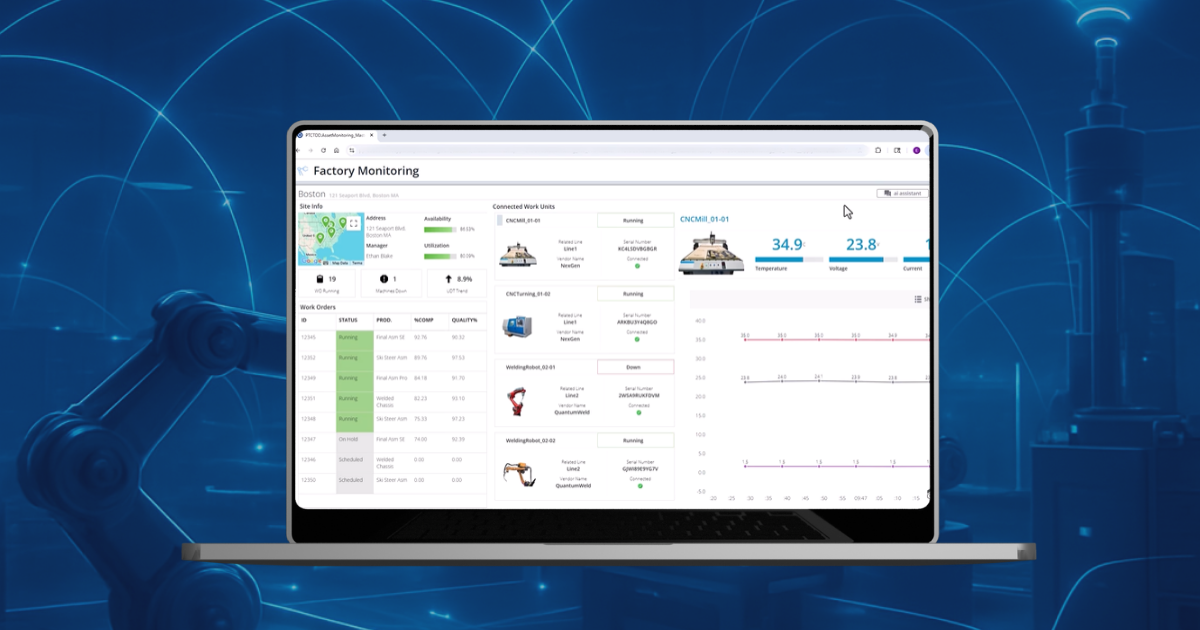
ThingWorx IIOT
What is IIoT and how does it benefit factories?
IIoT (Industrial Internet of Things) refers to the connection of machines, sensors, and various systems within a factory, enabling data to be collected, transmitted, and analyzed automatically. When shop-floor data is integrated into a centralized system, factories can:
1. Monitor machine status in real time
2. Analyze problems and identify root causes immediately
3. Receive alerts before failures or damage occur
4. Use data insights to improve production efficiency
How does an IIoT (industrial internet of things) system work?
The operation of an IIoT system can be summarized into five key steps:
1. Collecting data from machines
Various types of sensors are installed on machines to continuously measure and record operational data. This may include motor temperature, vibration levels, hydraulic pressure, energy consumption, or even the number of products moving through the production line.
2. Transmitting data to a centralized system
The collected data is transmitted through industrial communication protocols such as OPC-UA, MQTT, or Modbus via LAN, Wi-Fi, or 4G/5G networks. An Edge Gateway helps filter and compress the data before transmission, ensuring efficient and secure communication.
3. Processing and analyzing data
Once the data reaches the central system, the IIoT platform analyzes it using algorithms and Machine Learning technologies. The system can detect anomalies, identify trends indicating machine degradation, and predict when failures may occur.
4. Displaying results through dashboards and alerts
The analyzed information is presented through user-friendly dashboards accessible from both computers and smartphones. This allows management teams to monitor the overall factory status from a single screen. If abnormalities are detected, the system immediately sends alert notifications for rapid response.
5. Supporting decision-making
In this final step, the analyzed data is used for actual operational decision-making rather than simply being displayed on dashboards. The insights can be applied to optimize production schedules, plan predictive maintenance, and allocate resources more effectively. Machine Learning-based forecasting helps organizations make more accurate and data-driven decisions.
Introduction to ThingWorx
ThingWorx is an Industrial IoT platform developed by PTC that enables device connectivity, data management and analytics, as well as application development for building end-to-end IoT solutions. It is widely adopted across industrial sectors.
Since implementing IoT in manufacturing environments can be complex and challenging, ThingWorx is designed to simplify the process. It enables organizations to start with pilot projects and scale up to enterprise-level solutions using ready-to-use tools and features that accelerate development.
Why use ThingWorx?
ThingWorx simplifies IIoT implementation by enabling organizations to:
1. Connect to a wide variety of industrial machines and devices
2. Consolidate data from multiple systems into a single platform
3. Analyze data in real time
4. Rapidly build dashboards and applications
5. Centrally manage the entire IIoT system
Business benefits of IIoT with ThingWorx
1. Reduced machine downtime
ThingWorx supports Predictive Maintenance by analyzing machine data such as abnormal vibration levels or excessive motor temperatures. This allows maintenance teams to schedule maintenance during periods that minimize production disruption. Factories implementing this approach can significantly reduce unplanned downtime.
2. Lower maintenance costs
Reactive maintenance — or “fixing equipment only after failure occurs” — is far more expensive than predictive maintenance due to emergency spare parts, overtime labor costs, and production losses caused by unexpected shutdowns. With IIoT, maintenance teams can prepare spare parts in advance, schedule maintenance systematically, and utilize technical resources more efficiently, resulting in reduced maintenance costs.
3. Improved production efficiency (OEE)
OEE (Overall Equipment Effectiveness) is a key manufacturing KPI that measures three dimensions simultaneously: Availability (machine uptime and readiness), Performance (operating speed and efficiency), and Quality (rate of defect-free products). IIoT systems help improve all three areas at the same time. Factories adopting IIoT can increase OEE significantly, enabling higher production output without investing in additional machinery.
4. Reduced production waste
Sensors installed throughout the production line can detect abnormalities in real time, such as temperature deviations, inconsistent conveyor speeds, or incorrect pressure levels. This enables teams to stop and correct issues before defective products accumulate in large quantities. In addition, historical data can be used to analyze the root causes of quality problems and support long-term process improvement initiatives.
5. Faster and more accurate decision-making
Executives and production managers can access real-time operational data through dashboards and make immediate decisions regarding resource allocation, production planning, or issue response. This increases organizational agility and strengthens long-term competitive advantage.
Conclusion
Many factories already have data generated from machines and production systems, yet they are still unable to maximize the value of that data. As a result, organizations lack real-time visibility into operational issues and miss opportunities to improve production efficiency.
IIoT technology therefore plays a crucial role in connecting, collecting, and analyzing shop-floor data. When integrated with ThingWorx, it enables organizations to consolidate data from multiple systems into a single platform, analyze situations instantly, and present insights through easy-to-understand dashboards. These capabilities help executives and operational teams make faster decisions, reduce downtime and operational costs, and create long-term competitive advantages for the business.